

Search for “travertine price per m²” on Google and you will find vast ranges: from €20 to €150 per square metre. All are correct and all are useless at the same time. The price of travertine is not a number: it is a conversation. It depends on who you are talking to, where the stone comes from, and exactly what you need.
We have written this guide at Margar Stone, direct producers of travertine in Albox, Almería. We provide real indicative prices by variety and finish —to give you a starting point— and then we explain the factors that influence them. If after reading it you would like a personalised quote for your project, we are just a message away.
Indicative travertine prices by variety and finish
The table shows indicative prices for the main varieties in the Margar Stone catalogue for standard formats (random lengths × 30 cm, 2 cm thickness, supplied ex-works from Albox, Almería). Installation costs are not included.
| Variety | Finish | Price per m²* | Recommended use |
|---|---|---|---|
| Travertino Oro | Natural | €47–€50/m² | Façade · Exterior · Garden |
| Travertino Oro | Antiqued (R11) | €58–€62/m² | Façade · Pool · Terrace |
| Travertino Oro | Honed and Filled | €71–€75/m² | Interior flooring · Bathroom · Hallway |
| Travertino Oro | Polished and Filled | €75–€78/m² | Bathroom · Premium interior |
| Travertino Amarillo | Natural | €55–€59/m² | Façade · Exterior cladding |
| Travertino Amarillo | Antiqued (R11) | €65–€67/m² | Terrace · Pool · Exterior |
| Travertino Amarillo | Honed and Filled | €75–€77/m² | Interior flooring · Hospitality |
| Travertino Amarillo | Polished and Filled | €78–€82/m² | Bathroom · Interior |
| Travertino Grey | Natural / Antiqued | €55–€59/m² | Modern façade · Exterior |
| Travertino Clásico | Natural / Honed | €84–€89/m² | Interior · Exterior · Flooring |
| Travertino Crema | Honed / Polished | €80–€85/m² | Interior · Bathroom · Worktop |
* Indicative prices for tiles in random lengths × 30 cm, 2 cm thickness, ex-works (Albox, Almería). Transport and installation are not included. For special formats, bespoke slabs, or high-volume orders, please request a personalised quote.
💡 See a price that interests you? Write to us with the variety, finish, and approximate surface area of your project. We respond in less than 24 working hours with a tailored proposal.
→ Request a quote: margarstone.com/en/contact · info@margarstone.com
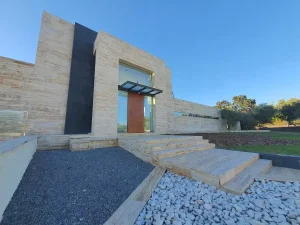
What really drives the price of travertine
Before deciding, it is worth understanding what lies behind these figures. Not all travertines on the market are comparable:
1. Origin: where does the stone come from?
This is the variable that creates the greatest price difference and the one least mentioned in catalogues. Most of the travertine sold in Spain comes from Italy, Turkey, and Iran. Its price is not necessarily low: investments in machinery and consumables are similar to European ones. The cost advantages of non-European countries stem mainly from differences in administrative and bureaucratic costs, and less control over working conditions. In any case, imported material has real limitations: less control over homogeneity between batches, greater variability in tone, and no traceability of the exact origin.
Margar Stone travertine is extracted entirely from the Los Marcelinos quarry, Albox —with ISO 9001 certification and CE Marking— and is processed 500 metres from the quarry mouth. We know which block and which sample each piece comes from. For projects with large surface areas or strict uniformity requirements, that traceability changes everything.
💡 When you ask any supplier for a quote, ask directly: where does this stone come from? If they cannot answer precisely, the material is likely imported.
2. Variety
The Travertino Oro is the most exclusive variety —its golden hue with cream veins only exists in the Albox quarry and has no equivalent in any other Spanish or European quarry. Travertino Amarillo, Travertino Clásico, or Travertino Crema are varieties with a more homogeneous presence on the market. Travertino Grey is seeing growing demand in contemporary architecture.
3. Finish
The finish is not just an aesthetic detail: it is a production process requiring specific time and machinery. Natural is the most economical (minimal intervention). Polished and filled is the most laborious. Antiqued —highly sought after for exteriors— has an intermediate but specific process: controlled wear that mimics the passage of time and provides R11 slip resistance.
→ Learn about all finishes in detail: margarstone.com/en/finishes
4. Format and thickness
The price table is calculated for tiles in random lengths × 30 cm with a 2 cm thickness, which is the most common format. Larger formats (60×60, 60×40, bespoke slabs) require larger blocks and have a higher cost. Thicknesses of 3 cm —common for staircases and high-traffic exteriors— also increase the price.
→ See also: Bespoke travertine slabs (margarstone.com/en/travertine-slabs)
5. Order volume
The higher the volume, the better the price per m². An order of 500 m² for a hotel has very different conditions to 15 m² for a bathroom. For large-scale projects, a personalised quote always improves upon the indicative rates in the table.
Which travertine is best for your project?
Exterior façades
Natural or antiqued. Antiqued Travertino Oro and Natural Travertino Amarillo are the most commonly used on Mediterranean façades. For projects with a more contemporary aesthetic, Travertino Grey is the choice.
→ See more: margarstone.com/en/cladding
The antiqued (R11) finish is the standard for exteriors and mandatory in wet areas. Antiqued Travertino Oro and Antiqued Travertino Amarillo are the most in demand. Antiqued travertine is also used inside swimming pools due to its resistance to water and treatment products.
→ See more: margarstone.com/en/swimming-pools · Exterior paving
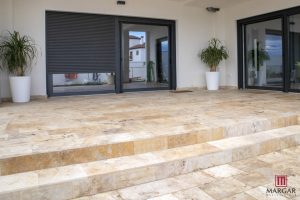
Bathrooms and interiors
Honed and filled or polished and filled. Polished and Filled Travertino Oro is the benchmark for high-end residential projects. For a warmer, less glossy result, choose honed.
→ See more: margarstone.com/en/bathrooms
Hospitality and public spaces
Honed and filled for its resistance to heavy traffic. Travertino Oro, Travertino Amarillo, and Travertino Clásico are the most used due to their character and durability.
→ See more: margarstone.com/en/projects/hospitality
National vs. imported travertine: how it affects the price
The price difference between imported travertine and Margar Stone’s national travertine does exist and is real. But there are variables that rarely appear in a distributor’s quote:
Batch homogeneity: imported material can vary in tone between pallets of the same order. For façades or large surfaces where uniformity is required, this is a real problem that may force orders to be remade.
Replacement: if you need more material halfway through a project, obtaining pieces identical to those already installed can be impossible with imported material of uncertain origin.
Certifications: Margar Stone travertine has ISO 9001 and CE Marking. Not all imported material sold in Spain has these certifications.
💡 For a small project (a bathroom, a 20 m² terrace) where batch uniformity is not critical, low-cost imported material may suffice. For large projects, façades, or any work where visual consistency matters, the origin of the material is a technical variable, not a luxury.
Frequently Asked Questions
Do the prices in the table include transport?
No. Prices are ex-works (Albox, Almería). The cost of transport depends on the distance and the volume of the order. When requesting a quote, Margar Stone will indicate the transport cost to your destination.
How much does it cost to install travertine?
Installation is not included in the price of the material: it is carried out by the client’s installer. As a general reference, laying natural stone paving or cladding usually costs between €45 and €65/m² depending on complexity (format, layout, stairs, joints). We recommend always requesting an installation quote separately.
Can I see samples before placing an order?
Yes. At Margar Stone we offer material samples so you can see the real tone and texture before deciding. For any type of project, it is also possible to visit our facilities in Albox. Contact us to request them.
What is the difference between filled and open-pore travertine?
“Filled” means that the natural pores of the stone are filled during finishing, leaving a smoother and more homogeneous surface. “Open-pore” or “natural” leaves the pores visible —a more organic and authentic look. For interiors, filled is usually preferred; for exteriors, open-pore or antiqued.
Can travertine be used in swimming pools?
Yes, it is one of the most sought-after materials for pool edges and terraces. The antiqued (R11) finish is the most suitable due to its natural slip resistance. Travertine is also used inside the pool shell. It is important to use appropriate adhesive mortar for exterior and water use. → See our swimming pools page.
Does travertine need maintenance?
Travertine does not require frequent maintenance. For exteriors, an annual cleaning with water is recommended and, if the material is porous, an initial water-repellent treatment. For interiors with a polished finish, clean with neutral products and avoid acids. The antiqued and honed finishes are the easiest to maintain: their texture does not show marks and does not require specific products.
Do you have a project in mind?
If you already have an idea of what you need —or if you are still choosing between varieties and finishes— at Margar Stone we can guide you. We respond to enquiries in less than 24 working hours and include guidance on material and finish without obligation.
→ margarstone.com/en/contact · info@margarstone.com · +34 950 430 830